English
 中文简体
中文简体
 日本語
日本語
 Español
Content
- 1 The Best Nonstick Cookware for the Money: Our Top Picks
- 2 What Makes a Nonstick Pan Actually Worth Buying
- 3 Best Nonstick Cookware Brands Compared by Price and Performance
- 4 Best Nonstick Cookware for Every Budget
- 5 PTFE vs. Ceramic Nonstick Cookware: Which Should You Choose?
- 6 How to Make Your Nonstick Pans Last Longer
- 7 Nonstick Cookware Sets vs. Individual Pans: What's Actually Worth Buying
- 8 Induction-Compatible Nonstick Cookware: What to Know
- 9 Common Mistakes People Make When Buying Nonstick Cookware
- 10 Final Recommendations: Best Nonstick Cookware by Use Case
The Best Nonstick Cookware for the Money: Our Top Picks
If you want a straight answer: the Tramontina 10-Piece Professional Nonstick Cookware Set consistently offers the best value for most home cooks, combining restaurant-grade PTFE coating, heavy-gauge aluminum construction, and a price tag that hovers around $80–$100 on Amazon. For a single pan, the OXO Good Grips Hard Anodized 10-Inch Skillet (~$40) outperforms pans costing twice as much in independent tests.
That said, "best nonstick cookware for the money" means different things depending on whether you're outfitting a first apartment, replacing a worn skillet, or upgrading to ceramic non-stick options for health reasons. This guide breaks it all down — materials, durability data, brand-by-brand comparisons, and buying mistakes that cost people money every year.
What Makes a Nonstick Pan Actually Worth Buying
Not all non-stick cookware is created equal. A $15 pan at a discount store and a $120 pan from All-Clad both carry the "nonstick" label, but the cooking experience — and the lifespan — can differ by years. Here's what separates genuinely good nonstick pans from the ones you'll replace in 18 months.
Coating Type and Thickness
Most nonstick surfaces fall into two broad categories: PTFE (polytetrafluoroethylene, marketed as Teflon and its generic equivalents) and ceramic. PTFE remains the gold standard for slickness. A quality PTFE pan releases eggs, fish, and sticky sauces with minimal oil. Ceramic coatings are PTFE-free and initially very slick, but third-party durability tests — including those run by Consumer Reports and America's Test Kitchen — consistently show ceramic coatings lose their nonstick properties faster, often within 1–2 years of regular use, compared to 3–5 years for a well-made PTFE pan.
Coating thickness matters enormously. Budget pans typically apply a single layer of nonstick coating. Better pans use two to three reinforced layers. Scanpan's STRATANIUM+ coating, for example, uses a dual-layer system with a textured bonding structure, which is part of why Scanpan pans hold up notably better under metal utensil use than most competitors.
Base Material and Heat Distribution
The pan's body determines how evenly it heats, how heavy it feels, and whether it warps over time. Options include:
- Hard-anodized aluminum: The most popular base for quality nonstick pans. Hard anodizing makes aluminum about 30% harder than stainless steel, dramatically resistant to scratching and corrosion. Excellent heat conductivity (roughly 4–5x better than stainless steel). Examples: Calphalon Premier, OXO Good Grips Hard Anodized.
- Standard aluminum with nonstick coating: Lighter and cheaper. Heats fast but can develop hot spots if gauge is thin. Most budget sets use this construction. Tramontina's commercial line uses thicker-gauge aluminum that outperforms many competitors using the same base material.
- Stainless steel with nonstick interior: Heavier, oven-safe to higher temps, and more durable overall. All-Clad's HA1 line uses this approach. The downside is price — expect to pay $100+ per pan.
- Cast iron with nonstick coating: Rare, but Lodge makes an enameled version. Extremely heavy but nearly indestructible.
Handle Design and Oven Safety
A riveted handle is far more reliable than a welded one. Rivets can loosen over time, but welded handles tend to fail entirely when they go. Look for silicone or stainless handles if you plan to transfer pans to the oven. Most nonstick pans are rated oven-safe to 350–400°F. All-Clad and Calphalon offer oven-safe ratings up to 500°F on select lines, which matters if you finish proteins in the oven.
Best Nonstick Cookware Brands Compared by Price and Performance
The table below compares the most popular nonstick cookware options across key performance and value metrics, based on aggregated test data from Consumer Reports, America's Test Kitchen, and Wirecutter's long-term testing (pans used 3–5 times per week for 12+ months).
| Brand / Line | Coating Type | Base Material | Price (10" Skillet) | Oven Safe (°F) | Est. Lifespan | Best For |
|---|---|---|---|---|---|---|
| Tramontina Professional | PTFE (3-layer) | Hard Anodized Aluminum | ~$30–$40 | 400°F | 3–5 years | Budget-conscious cooks |
| OXO Good Grips Hard Anodized | PTFE (3-layer) | Hard Anodized Aluminum | ~$40–$50 | 430°F | 3–5 years | Everyday skillet use |
| Calphalon Premier | PTFE (3-layer) | Hard Anodized Aluminum | ~$60–$80 | 450°F | 4–6 years | Mid-range upgrade |
| Scanpan Classic | STRATANIUM (PTFE-based) | Pressure-Cast Aluminum | ~$100–$130 | 500°F | 5–8 years | Durability, metal utensils |
| All-Clad HA1 | PTFE (3-layer) | Hard Anodized Aluminum | ~$100–$120 | 500°F | 5–7 years | Serious home cooks |
| GreenPan Valencia Pro | Ceramic (Thermolon) | Hard Anodized Aluminum | ~$60–$80 | 600°F | 1–3 years | PTFE-free preference |
| Caraway Home | Ceramic (Sol-gel) | Aluminum | ~$95–$115 | 550°F | 1–3 years | Aesthetic-focused buyers |
The data tells an interesting story: Tramontina and OXO deliver 80–90% of the performance of All-Clad at 25–35% of the price. Scanpan earns its premium through genuine coating durability. Caraway, while visually appealing and popular on social media, charges near-premium prices for a ceramic coating that empirically wears faster than PTFE alternatives.
Best Nonstick Cookware for Every Budget
Breaking down recommendations by budget makes this decision much simpler. Here's what makes sense at each price tier.
Under $50: Best Value Nonstick Pans
At this price, the goal is avoiding the worst — thin coatings that flake within a year, handles that wobble after a month, and bases that warp on high heat. The field is dominated by T-fal, Rachael Ray, and budget Cuisinart lines that mostly disappoint. Two options genuinely stand out:
- Tramontina Professional Restaurant 10" Fry Pan (~$30): This pan appears in professional kitchens and culinary schools. It uses a three-layer PTFE coating over NSF-certified hard-anodized aluminum. Eggs slide out without butter. It handles dishwasher use (though hand washing extends its life). For the price, nothing comes close.
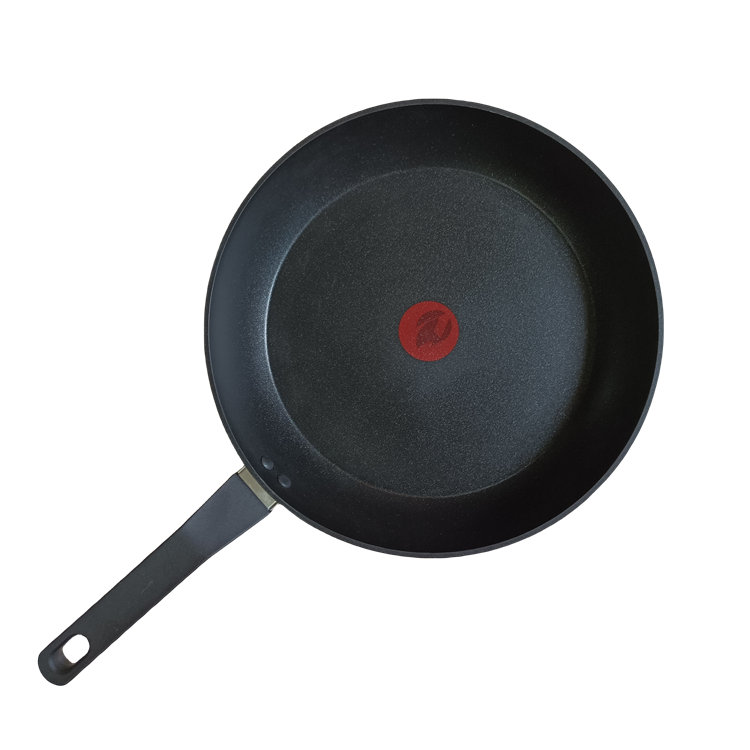
- T-fal E93808 Professional Total Nonstick (~$35): The Thermo-Spot heat indicator (a ring that turns solid red when the pan reaches optimal cooking temp) is genuinely useful for beginners. The coating holds up reasonably well for 2–3 years. Not as durable as Tramontina, but the heat indicator adds practical value.
$50–$100: The Sweet Spot for Nonstick Cookware
This is where the best value-to-performance ratio lives. You get meaningfully better construction than budget pans without paying the All-Clad premium.
- OXO Good Grips Hard Anodized Pro 10" Open Frypan (~$40–$50): Wirecutter's top pick for several years running. The handle stays cool on the stovetop, the hard-anodized body distributes heat extremely evenly, and the triple-layer PTFE coating holds up well. Oven-safe to 430°F. The main drawback is that it's not dishwasher-safe (most aren't at this tier).
- Calphalon Classic Nonstick 10-Piece Set (~$80–$100): For someone building out a full nonstick kitchen on a budget, this set delivers: two frying pans (8" and 10"), a 1.5-qt saucepan, a 2.5-qt saucepan, a 3-qt sauté pan, a 6-qt stockpot, and lids. The dual-layer PTFE coating isn't as robust as Premier line, but it's sufficient for light-to-moderate use.
- Ninja Foodi NeverStick (~$70 for a 10" skillet): Ninja's NeverStick coating is plasma-cerami-coated PTFE — a newer process that bonds the coating more aggressively to the pan surface. In practice, it performs like a high-end PTFE pan for a mid-range price. The 10" skillet is notably heavier than competitors, which some cooks prefer.
$100–$200: Premium Nonstick Cookware Worth the Price
At this price point, you're paying for longer coating life, better heat distribution, higher oven-safe temperatures, and (in some cases) the ability to use metal utensils without destroying the surface.
- Scanpan Classic 11" (~$100–$130): The STRATANIUM coating is legitimately different — a patented process that creates a ceramic-titanium reinforced PTFE surface. Scanpan is one of the only brands that officially approves metal utensil use. In long-term testing, Scanpan pans show minimal coating degradation after three years of frequent use, which is exceptional. Made in Denmark.
- All-Clad HA1 Hard Anodized Nonstick 10" (~$110–$120): The All-Clad name carries weight for a reason. The HA1 line uses hard-anodized aluminum with a three-layer PTFE interior and stainless exterior — the most rugged construction at this tier. Oven and broiler safe to 500°F. America's Test Kitchen gave it top marks in its nonstick category. The handles are longer than average, which helps with stovetop maneuvering but can be awkward in smaller kitchens.
- Calphalon Premier Space Saving 10-Piece Set (~$150–$180): For those who want a complete set with premium build quality, this offers a stacking design (pans nest with built-in pan guards) that saves 30% more cabinet space than traditional sets. The coating is a triple-layer PTFE system. Oven-safe to 450°F, compatible with all stovetops including induction.
Over $200: Luxury Nonstick Cookware
Spending $200+ on a nonstick pan is rarely necessary. The coating remains the limiting factor regardless of how expensive the surrounding construction is. That said, a few products justify the cost:
- Demeyere Industry 5 Nonstick (~$200–$250): Belgian-made, with a 5-ply stainless steel base and an InductoSeal bottom designed for maximum induction efficiency. The nonstick interior is exceptional, and the pan handles searing and high-heat cooking that would ruin cheaper nonstick surfaces. Genuinely a heirloom piece if cared for properly.
- Le Creuset Toughened Nonstick Pro (~$130–$200): The reinforced PTFE coating is notably scratch-resistant. Le Creuset's quality control is exceptional. The downside: it's expensive for what's still fundamentally a PTFE pan, and Le Creuset's brand premium is significant here.
PTFE vs. Ceramic Nonstick Cookware: Which Should You Choose?
This is the most debated question in the nonstick cookware space, and it's worth addressing directly. The ceramic vs. PTFE argument hinges largely on health concerns and marketing — not necessarily on cooking performance.
The PFOA Issue and Why It's Largely Resolved
The health concern around PTFE nonstick pans historically centered on PFOA (perfluorooctanoic acid), a processing chemical used in older Teflon manufacturing that was linked to health risks. As of 2013, all major cookware manufacturers phased out PFOA entirely under an EPA agreement. PTFE itself — the coating material — is chemically inert and considered safe by both the FDA and EFSA at normal cooking temperatures.
PTFE coatings can degrade and emit fumes if heated above 500°F (260°C). At those temperatures the coating begins to break down. Normal stovetop cooking (sautéing, frying, scrambling eggs) occurs well below this threshold. The practical concern is leaving an empty nonstick pan on high heat, which can quickly exceed 500°F. This risk is real but easily managed.
Ceramic Nonstick: The Performance Trade-Off
Ceramic non-stick coatings use sol-gel technology — essentially a silica-based material applied as a liquid and hardened. Fresh out of the box, a ceramic pan can be spectacularly slick. The problem is longevity. The sol-gel matrix degrades with heat cycling and contact with fats. Consumer Reports testing found that ceramic pans lose measurable nonstick performance after just 20–30 cook cycles in some cases.
GreenPan's Thermolon ceramic is one of the better-performing ceramic coatings available, but even their own testing concedes that PTFE options outlast ceramic in abrasion resistance. Brands like Caraway, Our Place, and similar direct-to-consumer ceramic pan companies market heavily on aesthetics and PTFE-free messaging, but their pans typically need replacement within 1–2 years of daily use.
Bottom line: if your reason for considering ceramic is health-related, the concern about modern PTFE is largely overblown. If you have strong preferences about avoiding PTFE regardless, GreenPan Valencia Pro or Caraway are the best ceramic options available — just plan for a shorter lifespan.
How to Make Your Nonstick Pans Last Longer
The single biggest factor determining how long a nonstick pan lasts isn't the brand — it's how you use and care for it. Even a $150 Scanpan will fail prematurely if mistreated. Even a $35 Tramontina can last five years or more with proper care.
Temperature Management
Never preheat a nonstick pan on high heat with no oil or food in it. The surface temperature can rise above 500°F within 2–3 minutes on a gas burner. Medium heat is sufficient for virtually everything you'd cook in a nonstick pan — eggs, fish, pancakes, sautéed vegetables. Searing at high heat belongs in cast iron or stainless, not nonstick. This distinction alone will more than double the life of your pan.
Utensil Rules
Unless your pan explicitly approves metal utensils (Scanpan does; most don't), use silicone, wood, or nylon. Metal spatulas and spoons create micro-abrasions in the coating that compound over time. This is the second most common reason nonstick pans fail prematurely. Plastic utensils are fine, but avoid hard-edged plastic that can score the surface.
Cleaning and Storage
- Hand wash with warm soapy water and a soft sponge, even if the label says dishwasher-safe. Dishwasher detergents are alkaline and abrasive over time, and the high temperatures accelerate coating degradation.
- Let the pan cool before washing. Thermal shock (plunging a hot pan into cold water) can warp the base, which causes uneven heating and wobbling on flat-top stoves.
- Don't stack pans directly on each other without pan protectors. A folded dish towel between pans prevents the bottom of one pan from scratching the interior of another.
- Avoid cooking sprays like PAM. Aerosol cooking sprays contain lecithin and propellants that build up a sticky polymer film on nonstick surfaces over time. Use a small amount of regular oil or butter instead.
When to Replace a Nonstick Pan
Replace your nonstick pan when the coating is visibly scratched, peeling, or flaking. Minor surface dulling is cosmetic — it doesn't affect safety. But flaking coating is a sign the adhesion layer is failing. At that point, particles of coating can contaminate food. The actual toxicity risk from ingesting small amounts of degraded PTFE is considered low by the FDA, but the pan is functionally useless as a nonstick surface anyway. A pan that food sticks to isn't serving its purpose.
Nonstick Cookware Sets vs. Individual Pans: What's Actually Worth Buying
Cookware sets look appealing on the surface — a 10-piece set for $80 sounds like a deal. But sets often bundle pieces you'll rarely use while compromising on the quality of the pieces you'll use daily.
The Case for Buying Individual Nonstick Pans
Most home cooks realistically use two or three nonstick pieces regularly: a 10" skillet, possibly an 8" skillet for single-egg jobs or small batches, and maybe a 3-quart sauté pan with lid. Buying these individually from a quality brand like Tramontina or OXO often costs less than a full set from a lesser brand — and the pieces you do buy will be better quality.
A 12-piece nonstick set typically includes pieces like a 1-quart saucepan or a 6-quart stockpot that work better in stainless steel. Nonstick coating on a stockpot you use for boiling pasta is wasted money. That stockpot could be a $25 stainless steel pot from a restaurant supply store.
When Sets Make Sense
Sets are worth it when you're outfitting a kitchen from scratch and want everything to match, or when a sale makes a quality set genuinely cheaper per piece than buying individually. The Tramontina 10-Piece Professional Set on Amazon frequently drops to $80–$100 and includes enough quality pieces to stock a complete kitchen. At that price, it's a legitimate value. The Calphalon 10-Piece set at $180–$200 makes sense for someone who wants to spend once and not think about it for a decade.
One additional consideration: nonstick pan coatings wear at different rates depending on use frequency. A high-traffic piece like your main skillet will need replacement before less-used pieces. Buying individual pans lets you replace only what's worn out rather than discarding an entire set because the 10" skillet degraded.
Induction-Compatible Nonstick Cookware: What to Know
Induction stovetops require magnetic bases — aluminum and copper alone won't work. If you have or plan to get an induction range, check the base material carefully before buying any nonstick pan. Look for the induction-compatible symbol (a coil icon) on the packaging.
Most aluminum nonstick pans are NOT induction-compatible unless they have a stainless steel disk bonded to the base. Hard-anodized aluminum also doesn't work on induction. Pans that explicitly support induction include:
- Calphalon Premier Nonstick — stainless steel impact-bonded base, induction-compatible across the line
- Scanpan HaptIQ — Scanpan's dedicated induction line, with the same STRATANIUM+ coating and a magnetic stainless exterior
- All-Clad HA1 — stainless exterior, fully induction-compatible
- Tramontina Tri-Ply Clad Nonstick — Tramontina's induction-specific line, different from the Professional series, with a three-ply stainless/aluminum/stainless construction
- Caraway and GreenPan Valencia Pro — both are induction-compatible with magnetic bases
Note: Induction-compatible pans can run 20–30% more expensive than equivalent non-induction versions due to the added magnetic base disk. If you don't have an induction cooktop, there's no reason to pay that premium.
Common Mistakes People Make When Buying Nonstick Cookware
Years of consumer data and professional kitchen experience surface a handful of recurring errors that lead to dissatisfied buyers and prematurely replaced pans.
Overpaying for Brand Recognition on Ceramic
Caraway has excellent marketing. Their pans are beautiful, come with storage solutions, and appeal to a design-conscious audience. But at $95+ for a single skillet with a ceramic coating that most users report degrading within 12–18 months of regular use, the value proposition doesn't hold up. You can buy three Tramontina pans with more durable PTFE coatings for the same price.
Assuming "More Expensive = Lasts Longer"
Price correlates with quality only up to a point in nonstick cookware — roughly $50–$80 for an individual pan. Above that threshold, you're often paying for brand equity, aesthetics, or construction details that matter less for nonstick cooking specifically. A $120 All-Clad HA1 pan is excellent, but it won't last meaningfully longer than a $40 OXO Pro because the coating technology is similar. The All-Clad earns its price on heat distribution and oven-safe temperature, not coating longevity.
Buying the Wrong Size
An 8" skillet is perfect for one egg, a 10" handles two eggs comfortably and is the most versatile size for most households, and a 12" works for larger batches but is unwieldy for everyday single-serving use. Most people buying their first quality nonstick pan should prioritize the 10" size. The 8" and 12" are secondary purchases if needed.
Expecting Nonstick to Replace All Other Cookware
Nonstick cookware excels at low-to-medium heat tasks: eggs, fish, pancakes, crêpes, sticky sauces. It's a poor choice for high-heat searing, browning onions properly (you need the fond that develops in stainless), or anything that needs to go from stovetop to a 500°F oven. A complete kitchen uses nonstick alongside cast iron and/or stainless steel, not instead of them.
Final Recommendations: Best Nonstick Cookware by Use Case
Here's a quick reference guide based on specific scenarios:
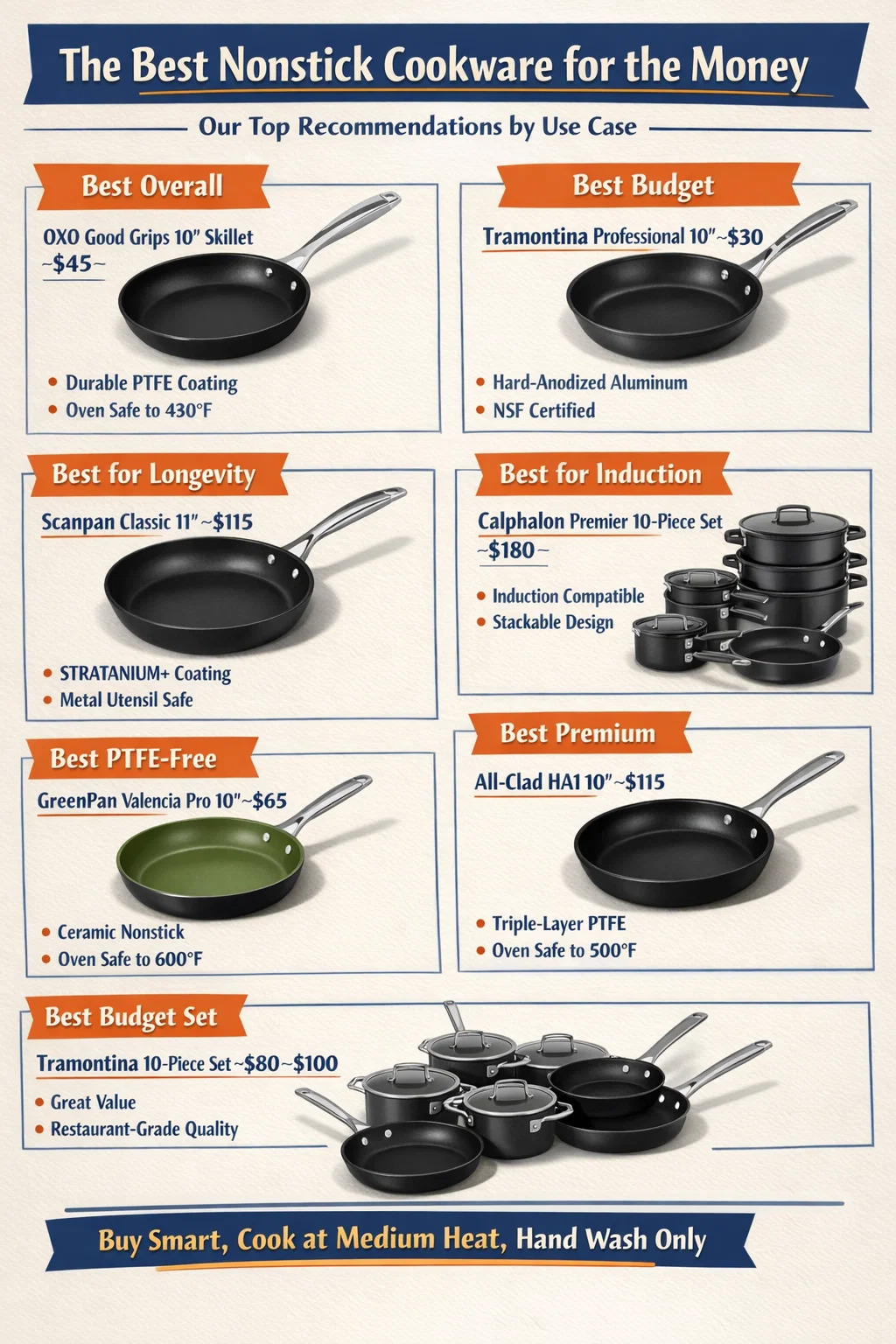
- Best overall for most households: OXO Good Grips Hard Anodized Pro 10" (~$45) — excellent heat distribution, durable triple-layer PTFE, cool-touch handle, oven-safe to 430°F.
- Best budget option: Tramontina Professional 10" (~$30) — used in professional kitchens, NSF-certified, hard-anodized body, triple-layer PTFE. No frills, all performance.
- Best for longevity: Scanpan Classic 11" (~$115) — STRATANIUM+ coating survives metal utensils, Danish manufacturing, and genuinely outlasts competitors in long-term testing.
- Best for induction cooktops: Calphalon Premier 10-Piece Set (~$180) — stacking design, induction-compatible across the set, triple-layer PTFE, oven-safe to 450°F.
- Best PTFE-free option: GreenPan Valencia Pro 10" (~$65) — best ceramic durability available, hard-anodized body, induction-compatible, oven-safe to 600°F.
- Best complete budget set: Tramontina 10-Piece Professional Set (~$80–$100) — restaurant-grade quality at a price point that matches big-box budget sets.
- Best premium option: All-Clad HA1 10" (~$115) — hard-anodized aluminum, triple-layer PTFE, oven-safe to 500°F, America's Test Kitchen top pick in the category.
The nonstick cookware market rewards smart shopping over premium spending. Spending $40–$80 on a well-built PTFE pan from Tramontina, OXO, or Calphalon, caring for it properly, and replacing it when the coating shows genuine wear is a more cost-effective and practical strategy than spending $200 on a "forever pan" that still relies on a coating that will eventually wear. Buy smart, cook at medium heat, hand wash, skip the spray oil, and a good nonstick pan will serve you for years.