English
 中文简体
中文简体
 日本語
日本語
 Español
Content
- 1 Why the Curved Shape Changes the Way You Cook
- 2 Choose a Wok That Matches Your Stove and Cooking Style
- 3 Prepare a New Wok Before the First Meal
- 4 Heat Control: The Hot-Wok-Cold-Oil Method
- 5 The Correct Order of Cooking in a Wok
- 6 Other Wok Techniques: Frying, Steaming, Braising, Toasting
- 7 Cleaning, Maintenance, and the Mistakes That Kill Woks
- 8 Wok FAQ
- 9 Final Thoughts
The fast path to a successful wok dish is simple: heat the empty wok on high until the surface is just below its smoke point, add 15 to 30 ml of a high-smoke-point oil, swirl it to coat the lower walls, and then cook in batches — sear the protein and set it aside, flash the aromatics, soften the vegetables, then return everything with noodles or rice and sauce in the final two minutes. Keep the heat high, keep each batch small, and the wok will outperform every other pan in your kitchen.
This guide covers the complete workflow: selecting a wok that matches your stove, preparing the surface for first use, controlling temperature, cooking in the correct order, using the wok for methods beyond stir-fry, and cleaning it without damaging the surface. Each step matters, because the wok is not a pan you can fill and leave alone — it only delivers when you respect the heat zones the shape creates.
The instructions here apply to traditional carbon-steel woks and modern non-stick aluminum models alike; wherever the two materials need different handling, the difference is spelled out in the relevant section.
Why the Curved Shape Changes the Way You Cook
A wok is not a deep frying pan. Its defining feature is the curved profile: a small, concentrated heating area at the bottom and walls that rise outward at roughly 60 degrees. That geometry creates a vertical temperature gradient — the center sears, the lower walls sauté, the upper walls hold cooked food at serving temperature without further cooking. In a flat skillet you get one temperature across the whole surface; in a wok you get three.
Round-bottom versus flat-bottom
Round-bottom woks are the traditional shape. They sit best on a gas burner with a wok ring, where the flame licks up the curved sides, and they give you deep tossing space. Flat-bottom woks have a small flattened base and are the practical choice for electric coil, ceramic-glass, and induction cooktops, because the full base contacts the heating element. The trade-off is a slightly shallower curve and a less dramatic toss.
| Factor | Round-bottom | Flat-bottom |
|---|---|---|
| Best burner | Gas with ring support | Induction, electric, ceramic-glass, gas |
| Stability | Needs ring or frame | Stable on any flat surface |
| Tossing space | Deep, full motion | Shorter, more contained |
| Heat contact | Concentrated central flame contact | Wide base contact |
| Best suited to | High-BTU traditional stir-fry | Home stoves, multi-purpose use |
The curvature is functional, not decorative. It is the reason a single pan can sear, steam, simmer, and deep-fry without changing tools, and a closer look at how the deep round-bottom design of a wok adapts to various cooking methods explains the mechanics behind each technique.
Choose a Wok That Matches Your Stove and Cooking Style
Before worrying about technique, match the wok to two things: the stovetop and the way you cook. Material is the first decision, because it determines weight, heat response, seasoning needs, and cleaning effort.
Wok materials compared
| Material | Weight (30 cm) | Heat response | Seasoning | Induction-compatible | Best for |
|---|---|---|---|---|---|
| Carbon steel | 1.0–1.5 kg | Fast | Yes | Only flat-bottom models | Traditional wok cooking, high heat |
| Cast iron | 3.0–4.5 kg | Slow, holds heat long | Yes | Usually yes | Searing, braising |
| Aluminum non-stick | 1.0–1.5 kg | Fast, even | No | Only with induction base | Daily low-oil cooking, eggs, sauces |
| Stainless steel | 2.5–3.5 kg | Slower | Optional | Yes | Browning then deglazing |
Published material property tables put aluminum at roughly 200 W/m·K thermal conductivity, about four times carbon steel's approximate 50 W/m·K. In practical terms, an aluminum wok spreads heat more evenly and recovers faster after cold food is added, but it also relies on a non-stick coating because bare aluminum reacts with acidic food. Carbon steel needs seasoning to build its own layer. The full comparison of how aluminum wok thermal conductivity compares with other materials shows where each material wins.
Size, handle, and base design
28 to 32 cm covers the realistic home range. A 30 cm wok suits one to four people without being too large to toss; 32 cm works better for family-sized batches but is noticeably heavier to handle. Long metal handles let you toss freely on gas, while two helper handles make lifting a full, heavy wok safer. Non-stick aluminum woks often use stay-cool or bakelite handles because the pan body heats quickly.
On induction, the base is non-negotiable: it must be flat and it must contain a magnetic layer, which means plain thin aluminum will not heat. A die-cast aluminum wok with an induction-compatible bottom combines aluminum's fast, even heat with the magnetic base induction requires — a common specification for European and North American home-kitchen buyers.
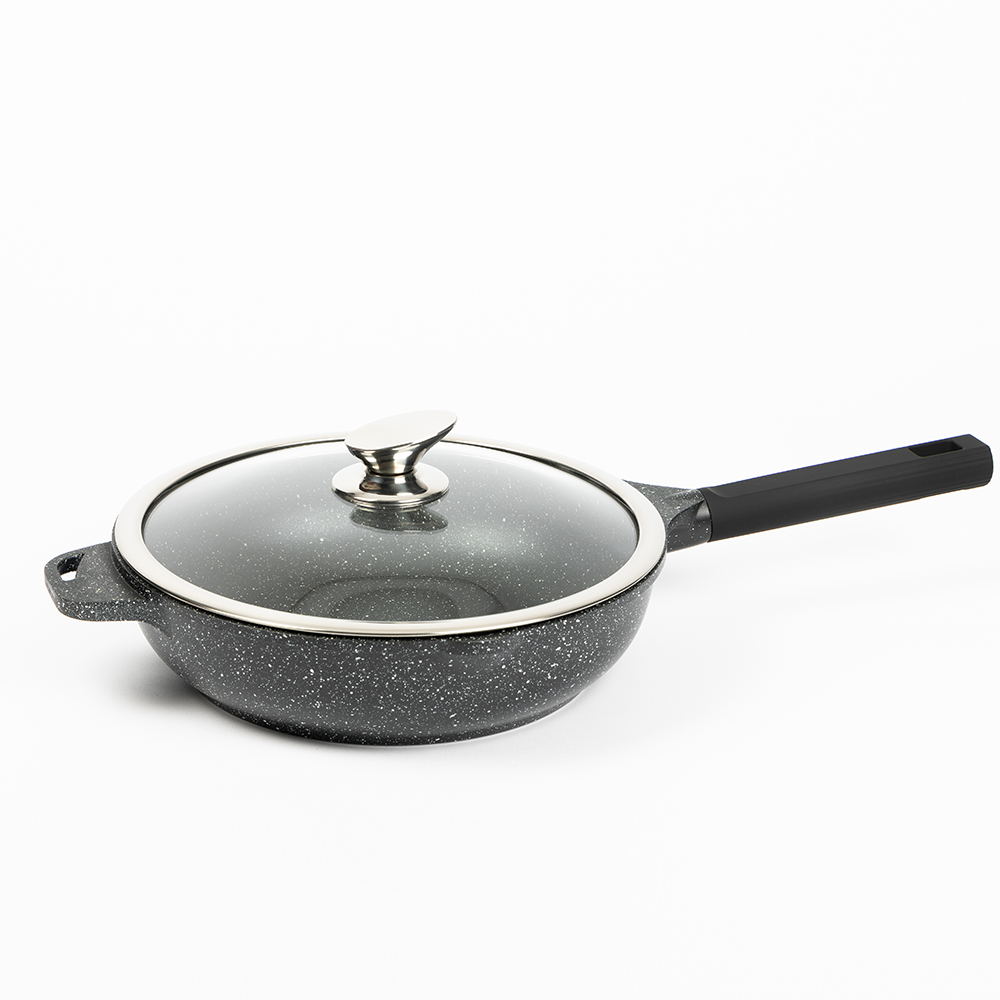
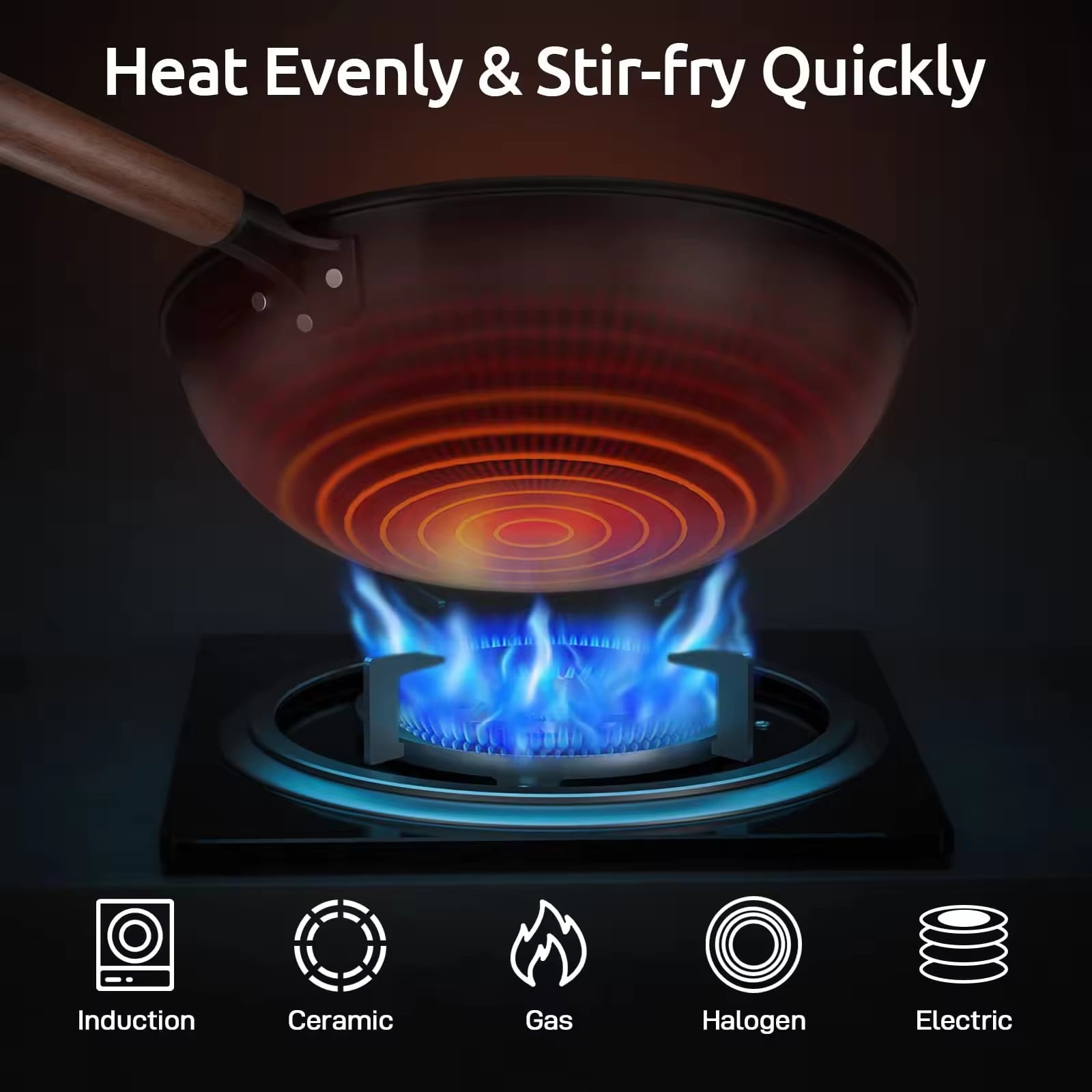 Die cast aluminum induction bottom wok fry pan non stick ceramic deep work with Ningbo Leer Kitchenware Co., Ltd is China Die cast aluminum induction bottom wok fry pan non stick ceramic deep work with lid suppliers a...View Product →
Prepare a New Wok Before the First Meal
A brand-new wok is not ready to cook with. Even when it looks clean, the surface carries factory residue: protective mineral oil, metal dust, or packaging film. Skipping the initial preparation is the most common reason a first stir-fry sticks.
Carbon steel and cast iron woks
- Wash the wok with hot water and dish soap, using a soft sponge. Remove every trace of the protective factory oil, then rinse twice.
- Dry the wok over a low flame, rotating it slowly so the whole surface dries evenly.
- Heat the wok on medium-high until the first wisp of smoke appears — the signal that the metal is ready to accept a seasoning layer.
- Add 10 to 15 ml of oil and wipe it over the entire inner surface with a folded paper towel held by tongs. Let the oil smoke for 60 to 90 seconds.
- Cool the wok, then repeat steps 3 and 4 two or three times. The metal should turn bronze, then a dark honey color.
Once seasoned, a carbon-steel wok is naturally non-stick, and every subsequent high-heat cooking session with oil adds another thin layer of polymerized oil. The seasoning is the pan's real coating, so it needs to be maintained, not scrubbed off.
Non-stick aluminum woks
A non-stick wok skips the seasoning entirely. Wash it with warm water, mild dish soap, and a soft sponge, rinse thoroughly, and dry it over medium heat until every drop is gone. No oil cure is needed. In fact, heating a coated wok empty on high for several minutes damages the coating instead of improving it.
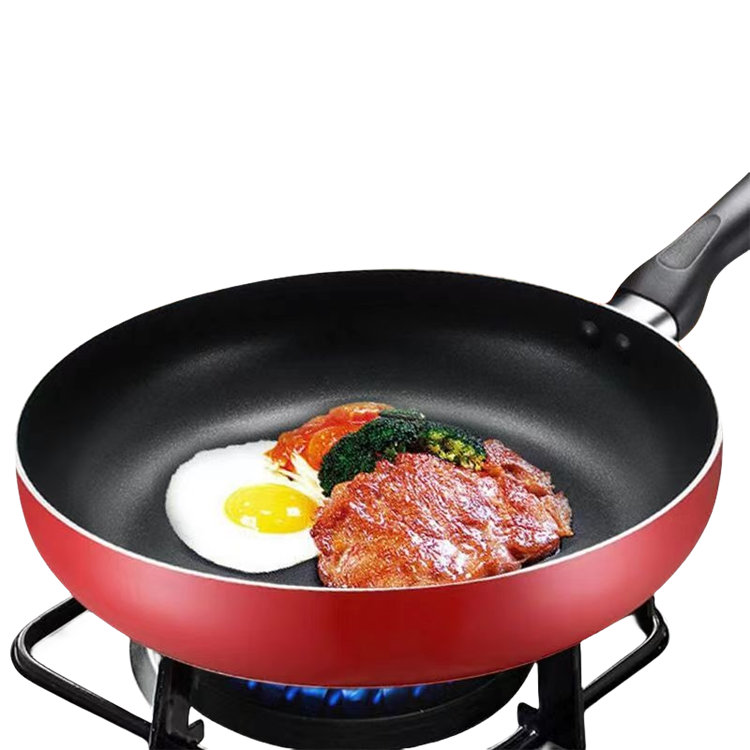
For daily low-oil cooking, a dishwasher-safe non-stick aluminum stir-fry wok is the most convenient option, because it needs no re-seasoning and handles eggs, tofu, and sticky sauces without extra oil.
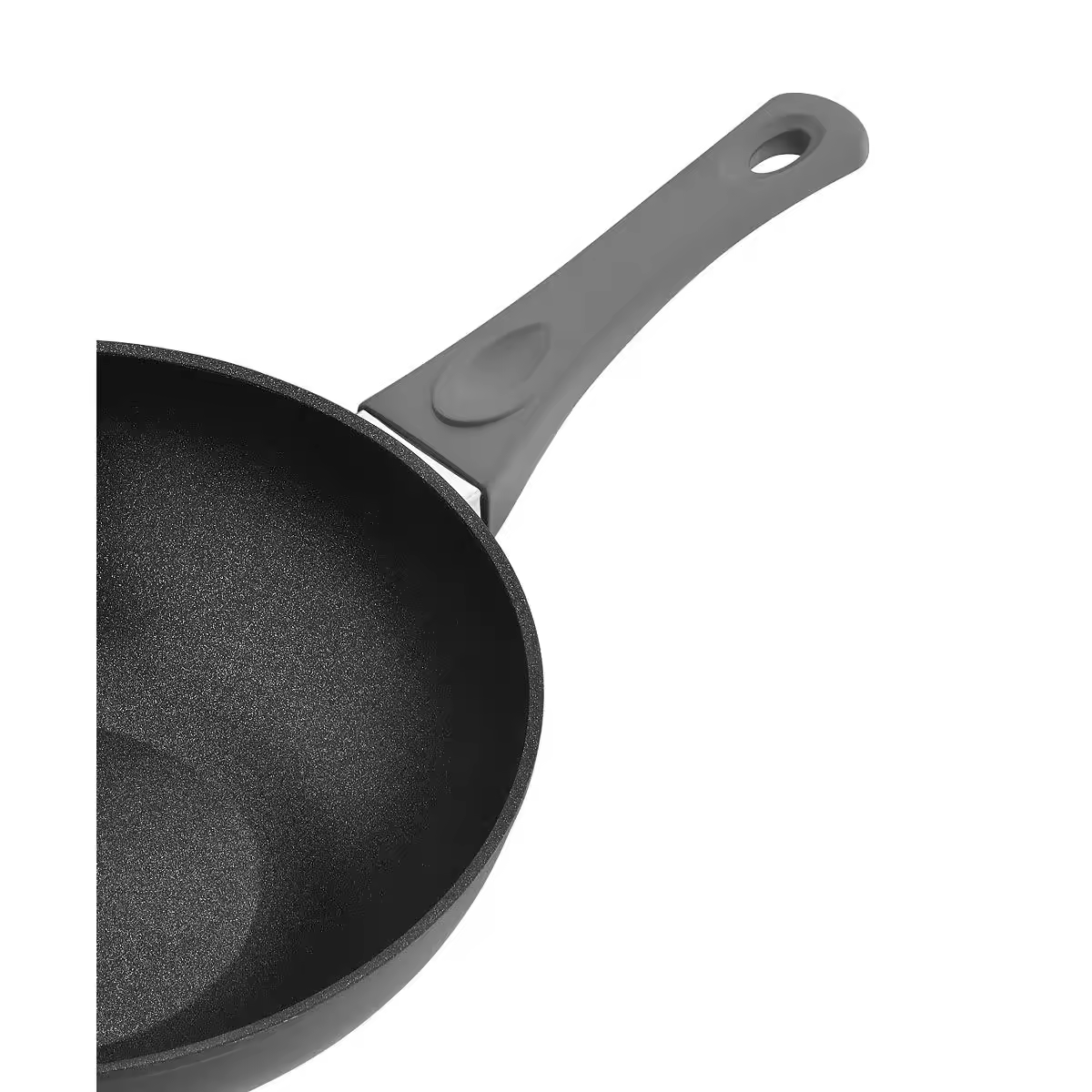 customised logo no chemical dishwasher-safe aluminum nonstick stir-fry wok pan SNingbo Leer Kitchenware Co., Ltd is China customised logo no chemical dishwasher-safe aluminum nonstick stir-fry wok pan suppliers and cu...View Product →
Heat Control: The Hot-Wok-Cold-Oil Method
The single most useful habit in wok cooking is the sequence known as hot wok, cold oil. It is not tradition; it is physics, and it fixes most sticking problems before they start.
What "hot wok, cold oil" actually means
Heat the empty wok first. Only after the metal is hot do you add oil, and then immediately add food. The reason: hot metal expands its surface structure slightly, the oil flows into the microscopic gaps and forms a continuous barrier, and food stops touching bare metal. If oil and wok are heated together from cold, the oil degrades before the pan reaches searing temperature, and food welds to the surface. You also want oil that is hot but not smoking when the food lands — a light wisp on the oil is the last acceptable moment to add food.
Temperature cues and oil selection
A kitchen thermometer is useful, but you can read the wok without one. Water flicked into a dry wok that beads and rolls instead of evaporating flat means the surface is around 190 °C and ready for oil. A faint wisp of smoke rising from a dry carbon-steel wok means roughly 200 °C. Food should sizzle within one second of touching the oil; if the sizzle is weak or delayed, the wok is not hot enough.
The oil matters almost as much as the heat. High-smoke-point refined oils survive stir-fry temperatures; butter and cold-pressed olive oil break down too early.
| Oil | Approximate smoke point | Best use in a wok |
|---|---|---|
| Avocado oil | ~270 °C | High-heat searing, deep-frying |
| Rice bran oil | ~230 °C | Stir-fry, deep-frying |
| Peanut oil | ~230 °C | Classic stir-fry, nutty note |
| Grapeseed oil | ~215 °C | Neutral everyday stir-fry |
| Refined canola oil | ~205–220 °C | General wok cooking |
| Extra-virgin olive oil | ~160–190 °C | Low-heat finishing |
| Butter | ~150 °C | Finishing only, never searing |
The Correct Order of Cooking in a Wok
Stir-fry is a sequence of short, separate cooking events. Do not dump everything into the wok at the same time; the pan is too hot for a single mixed batch to work correctly.
- Heat the dry wok on high for about 30 seconds for a non-stick aluminum wok, or 45 to 60 seconds for carbon steel, until it passes the water-drop test. Add 15 to 30 ml of oil and swirl it so the entire lower wall is coated.
- Sear the protein in a single layer. Do not stir it for 30 to 45 seconds; let the surface brown. Flip, cook 30 to 45 seconds more, and transfer to a bowl. With a 30 cm wok, keep each batch to roughly 300 to 350 g.
- Add aromatics — minced garlic, sliced ginger, chilies, white parts of scallions — to the residual oil and toss for 15 to 30 seconds until fragrant. Keep the heat at medium-high so they soften rather than scorch.
- Add long-cooking vegetables, such as broccoli florets, sliced carrots, or peppers, and stir-fry for 1 to 2 minutes until crisp-tender.
- Add quick-cooking vegetables, like spinach, bean sprouts, chives, or mushrooms, and toss for 45 to 90 seconds.
- Return the protein with any resting juices, add noodles or cooked rice and the sauce mixture, and toss for 1 to 2 minutes over medium-high heat until everything is glossy and hot.
| Stage | Time | Cue | Heat |
|---|---|---|---|
| Protein searing | 60–90 s per batch | Golden crust, releases easily | High |
| Aromatics | 15–30 s | Fragrant, not browned | Medium-high |
| Long vegetables | 1–2 min | Fork-tender with bite | High |
| Quick vegetables | 45–90 s | Bright color, crisp | High |
| Sauce and noodles | 1–2 min | Glossy, coated, no liquid pool | Medium-high |
The total active cooking time for a stir-fry is usually 6 to 9 minutes. When it drags longer, the wok is too cold or the batch too large. Overcrowding is the classic failure mode: adding 700 to 800 g of vegetables at once collapses the surface temperature below the boiling point of water, the vegetables steam and release liquid, and the result is a wet, dull dish. Cook in batches when in doubt, and use the upper wall of the wok as a warm holding zone for finished batches.
Other Wok Techniques: Frying, Steaming, Braising, Toasting
The same curved shape that makes stir-fry work also makes the wok a competent tool for deep-frying, steaming, braising, and dry-toasting. Only the heat and the amount of liquid change.
Deep-frying
Fill the wok to roughly 5 cm of oil — about 1 to 1.5 liters depending on diameter — and hold the temperature between 170 and 190 °C. The wide bottom increases the surface area used by the food, so batches fry faster and more evenly than in a narrow saucepan with the same oil volume. Use a thermometer; it is difficult to judge 180 °C by eye.
Steaming
Add 1 to 2 cm of water or stock and place a bamboo steamer or wire rack above the liquid. The curved bottom keeps the liquid centered directly beneath the steamer, and the deep walls trap steam better than a shallow skillet with a lid. Dumplings, fish fillets, and vegetables take 5 to 20 minutes depending on size.
Braising and saucy dishes
After a quick sear, add stock, soy, or a tomato-based sauce, bring it to a simmer, cover with a lid, and lower the heat. Because the wok narrows at the bottom, even a small volume of liquid stays deep enough to cook the ingredients evenly. A scratch-resistant non-stick wok with a lid is particularly good for braises, because the coating resists tomato and vinegar sauces that cling to bare metal, and the lid prevents the sauce from reducing too fast.
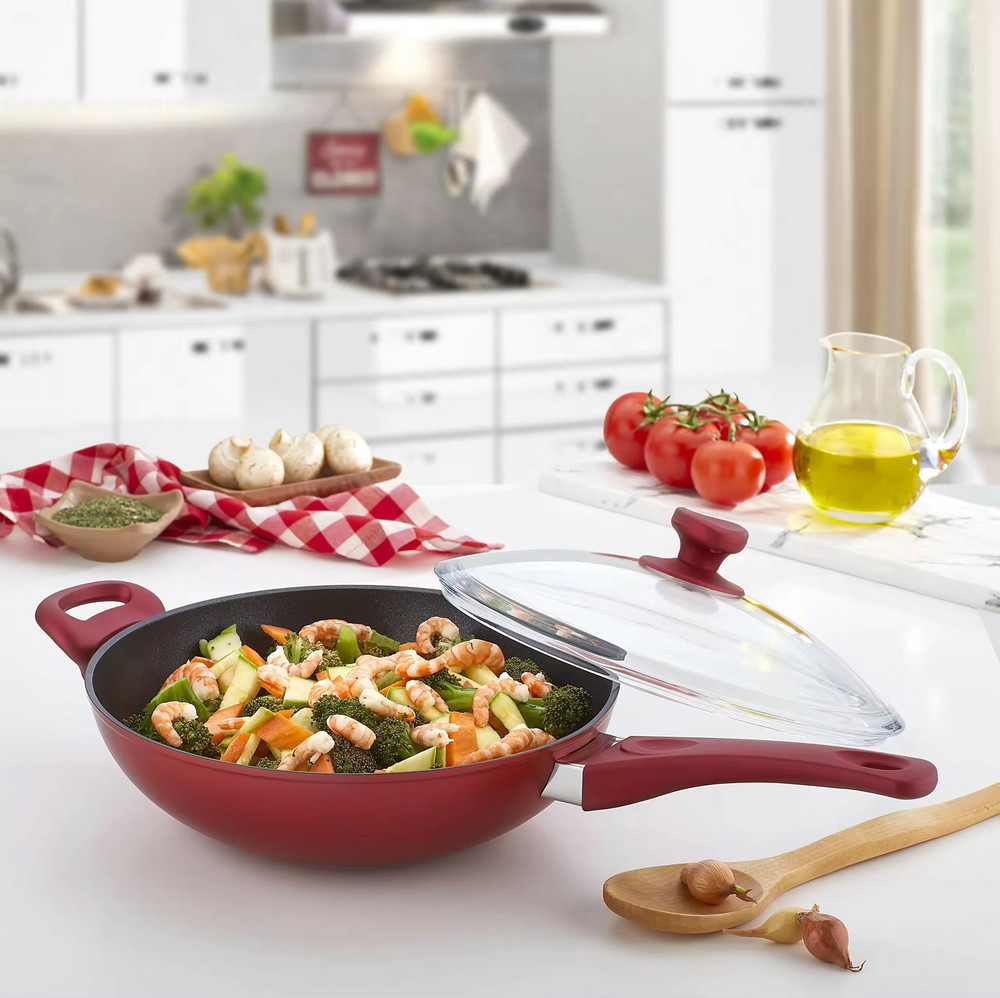 Multi purpose scratch resistant custom logo kitchen aluminum non-stick wok pan wNingbo Leer Kitchenware Co., Ltd is China Multi purpose scratch resistant custom logo kitchen aluminum non-stick wok pan with lid supplie...View Product →
Dry-toasting
A dry wok over medium-low heat toasts sesame seeds, peanuts, cumin, or rice for grinding. Shake the pan every 15 to 20 seconds; the curved walls push the grains back toward the center, so the toasting is even and you do not need to stir constantly.
Cleaning, Maintenance, and the Mistakes That Kill Woks
How you clean the wok matters as much as how you cook in it. The core rule: never shock the pan with a sudden temperature change, and never use harsher abrasives than the surface can take.
Cleaning a non-stick aluminum wok
Let the wok cool completely before washing. Dropping a hot coated wok into cold water is the most common cause of premature coating failure. Wash with warm water, mild dish soap, and a soft sponge; skip steel wool and abrasive scrub pads. If the wok is labeled dishwasher-safe, hand washing still protects the coating longer than any machine cycle.
Cleaning a carbon-steel wok
After cooking, fill the warm wok with hot water and swirl for about 30 seconds to loosen food. A stiff brush handles the rest; soap is not needed for daily use. Dry the wok over low heat until no moisture remains, then rub a few drops of oil across the surface. If food is burned on, heat water in the wok first to soften the residue before brushing.
Common mistakes that shorten wok life
- Heating an empty non-stick wok to full smoke — the coating degrades at very high dry heat.
- Soaking a wok overnight — rust on carbon steel, blistering on some coatings.
- Adding cold, wet food to a crowded wok — it steams instead of searing.
- Using metal spatulas or forks on non-stick coatings — small scratches become peeling points.
- Rinsing a hot wok under cold tap water — this warps aluminum and can crack seasoning.
- Stacking pans without a cloth or paper-towel layer — the base of the upper pan scrapes the one below.
Re-season carbon steel as soon as food starts sticking or the surface looks patchy. Non-stick woks do not get re-seasoned; when food no longer releases easily, the coating has reached the end of its service life, and the correct solution is a new wok.
Wok FAQ
Do you need to season a non-stick wok?
No. A non-stick wok is ready after a wash and a thorough dry. Seasoning a coated wok leaves a polymerized oil layer and can gradually interfere with the original release performance.
How do I know when the wok is hot enough?
Use the water-drop test: if two drops bead and roll across the surface instead of evaporating flat, the surface is around 190 °C. On carbon steel, the first thin wisp of smoke from the dry wok is another cue — roughly 200 °C. On a non-stick wok, never wait for smoke; preheat for about 30 seconds on medium-high at most.
Can I use a wok on an induction cooktop?
Only if the base is flat and contains a magnetic layer. Plain thin aluminum woks will not activate induction. Non-stick aluminum woks need a bonded magnetic base, so always verify the base construction before purchase.
Why does food stick even when I use enough oil?
Usually one of four causes: the wok was not hot enough when the food went in, the protein was wet or sugar-glazed from a marinade, the pan was overcrowded so the temperature collapsed, or the carbon-steel seasoning layer had worn away. Fix the preheating first; it is the most common and the easiest to correct.
A wok is only for stir-fry, right?
No. Deep-frying, steaming, braising, boiling noodles, and dry-toasting all work in the same pan. The shape concentrates heat for steaming and frying, while the volume holds enough liquid for a braise. In many Asian home kitchens, the same wok cooks every meal of the day.
Final Thoughts
Used correctly, a wok becomes the most-used pan in a kitchen, because it combines the speed of a skillet, the volume of a pot, and the fine control of a seasoned surface. None of that comes from exotic skill; it comes from temperature, order, and batch size. Keep the wok hot, keep the batches small, prepare the surface once, maintain it after every meal, and the results stay consistent for years.
On the manufacturing side, the performance of a wok is decided before it leaves the factory: wall thickness of roughly 2.2 to 2.5 mm for forged aluminum bodies, base construction that works on both gas and induction, and a coating matched to the intended use. For brand owners, distributors, and restaurant chains buying woks under a private label, those specifications determine whether end users keep or return the product. You can discuss custom wok specifications with the manufacturing team to match shape, size, handle, and coating to a specific market.