English
 中文简体
 日本語
 Español
Content
- 1 The Quick Answer: What Size Is a Standard Dutch Oven?
- 2 Dutch Oven Size Chart: Quarts, Centimeters, and Servings
- 3 Small Dutch Ovens: 1 to 3.5 Quarts
- 4 Medium Dutch Ovens: The 4.5 to 6 Quart Sweet Spot
- 5 Large Dutch Ovens: 7 to 13 Quarts
- 6 Round vs. Oval Dutch Ovens: Shape Changes What Fits
- 7 How to Choose the Right Dutch Oven Size in 4 Steps
- 8 Aluminum vs. Cast Iron: Does Material Change the Ideal Size?
- 9 Weight and Dimensions to Expect at Each Size
- 10 What Buyers Should Check When Ordering Dutch Ovens from a Manufacturer
- 11 Dutch Oven Size FAQs
- 11.1 How big is a standard Dutch oven?
- 11.2 What size Dutch oven do I need for a family of four?
- 11.3 What size Dutch oven is best for sourdough bread?
- 11.4 How many liters is a 5.5 qt Dutch oven?
- 11.5 Is a 7-quart Dutch oven too big for two people?
- 11.6 Can a Dutch oven be used on an induction cooktop?
- 11.7 Is a Dutch oven the same as a casserole pot?
Picture this: you are ready to buy a Dutch oven, so you open the product catalog, and the size filter lists everything from 1 quart to 13 quarts. How big is a Dutch oven, exactly? The direct answer is that a standard Dutch oven holds 5 to 7 quarts (about 4.7 to 6.6 liters), and the most common single model is a 5.5-quart round pot around 24 to 26 cm in diameter. That size easily fits a 2 kg whole chicken, a four-to-six-portion stew, or a large sourdough loaf, which is why it is the default recommendation for most households. The rest of this guide explains every common size, what fits inside each one, and how to pick the right capacity before you buy.
The Quick Answer: What Size Is a Standard Dutch Oven?
A standard Dutch oven falls into one of three practical ranges:
- 5 to 5.5 quarts: the best-selling capacity worldwide. It feeds four to six people, fits a whole 2 kg chicken, a 1.5 kg pot roast, and a standard sourdough loaf.
- 6 quarts: the same serving range with extra headroom for bubbling sauces, big soup batches, and taller roasts. Choose this if you want one size larger than the recipe minimum.
- 7 quarts: the choice for six to eight people. It handles a 3 to 4 kg bird, a large chuck roast, or an eight-portion batch of chili.
The single most useful number to remember is 5.5 quarts. In metric terms, that is about 5.2 liters, or a pot roughly 24 to 26 cm across and about 15 cm deep inside. When a recipe simply says "use a Dutch oven," this is the size it assumes.
Dutch Oven Size Chart: Quarts, Centimeters, and Servings
Here is the complete size landscape in one chart.
| Capacity | Diameter | Feeds | What It Does Best |
|---|---|---|---|
| 1-2 qt | 16-18 cm | 1-2 people | Sauces, grains, side dishes, small desserts |
| 3-3.5 qt | 20-22 cm | 2-3 people | Soup, small roasts, small bread loaves |
| 4.5-5 qt | 22-24 cm | 3-4 people | Everyday family meals, standard stews |
| 5.5-6 qt | 24-26 cm | 4-6 people | Whole chicken, standard bread, one-pot dinners |
| 7-8 qt | 26-28 cm | 6-8 people | Large stews, big batches, large poultry |
| 9-13 qt | 30-35 cm | 8-12+ people | Whole turkey, batch cooking, catering |
Two details matter when you read this chart. First, the advertised quart size is the brim capacity; the usable capacity is lower once you leave headroom for bubbling and the lid. Second, the quart number on the label is usually a US quart, and one US quart equals about 0.95 liter. That means a 5 qt pot does not hold a full 5 liters of stew.
Small Dutch Ovens: 1 to 3.5 Quarts
Small Dutch ovens sit between 1 and 3.5 qt, with pot diameters of 16 to 22 cm. They work as everyday pots for one or two people or as helper pots in a busy kitchen.
Why You Would Buy One
- Cooking for one or two: a 2 to 3.5 qt pot makes soup, curry, or braised meat without a week of leftovers.
- Side dishes: rice, quinoa, braised greens, mac and cheese, and sauces that need a wide pot and a lid.
- Small bread: a 3.5 qt round pot turns out a 400 to 500 g flour boule with good oven spring.
- Fast heating: a smaller pot reaches cooking temperature sooner and uses less energy than a large one.
What You Give Up
- Most published recipes assume a 5 qt or larger pot, so a 3 qt model forces you to scale ingredients down.
- A whole chicken will not fit, and neither will large roasts or batches bigger than two or three portions.
- A small pot cools faster the moment the lid is lifted, so long braises hold heat less steadily.
A small Dutch oven is a sensible second purchase, not the best first purchase.
Medium Dutch Ovens: The 4.5 to 6 Quart Sweet Spot
Medium sizes, from 4.5 to 6 qt, are where most households should start. This range covers three useful capacities:
- 4.5 qt (22-24 cm): a compact family pot for three people; fits a 1.5 kg chicken and a three-portion stew; ideal when storage is tight.
- 5.5 qt (24-26 cm): the most popular size in the world. It is the minimum for a whole 2 kg chicken with vegetables, the sweet spot for sourdough, and the default capacity for recipe development.
- 6 qt (26 cm): the same serving range with more vertical room; useful for wet dishes that bubble up, like pasta sauce, deep braises, and soups finished with cream.
What actually fits inside a 5.5 qt pot:
- A whole chicken up to 2.3 kg
- A pot roast of about 1.8 kg
- Six to eight servings of chili or stew
- A sourdough loaf made from 500 to 600 g of flour
A 5.5 qt pot also matches modern induction cooktops well: its 24 to 26 cm base aligns with common induction zones, so the bottom heats evenly without a hot ring.
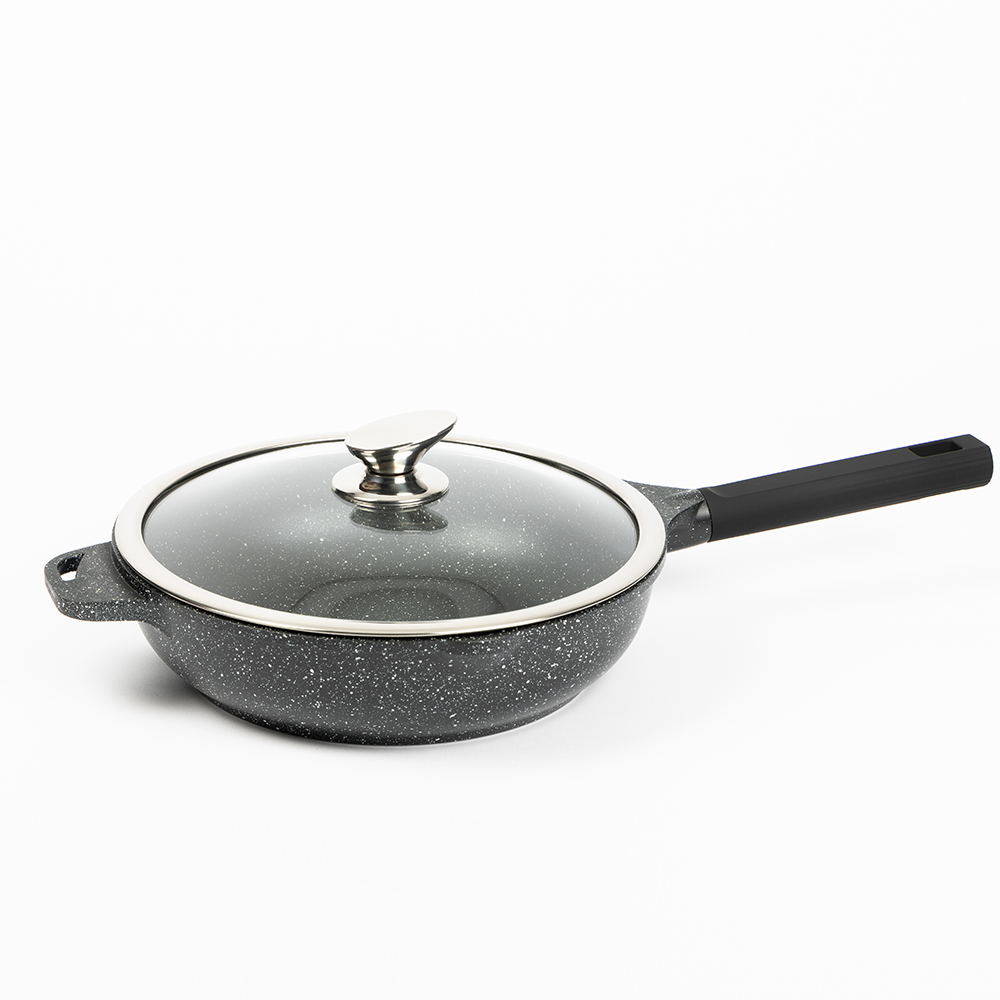
 5.5 Quart Nonstick Aluminum Dutch Oven with LidThis 5.5-quart aluminum Dutch oven features a nonstick interior and a lid, sized to match modern induction zones for even heating while fitting standard cabinets.View Product →
Many cooks buy a single 5.5 qt pot as their entire Dutch oven. It cooks dinner for four, leaves room for a weekend loaf of bread, and still fits in a standard cabinet.
Large Dutch Ovens: 7 to 13 Quarts
Large Dutch ovens start at 7 qt and go up to 13 qt or more. They exist for a reason, but that reason is not everyday cooking for two.
- 7-8 qt (26-28 cm): for six to eight people. It fits a 3 to 4 kg chicken or duck, a thick beef roast, or a double batch of soup made for freezing.
- 9-13 qt (30 cm and above): crowd cooking. Whole turkeys up to 5 to 6 kg, seafood boils, stock batches, and camp cooking for large groups.
Before You Choose a Large One
- Slower to heat: a 7 qt pot needs more time and energy to reach a steady simmer than a 5 qt pot.
- Hard to move: even a lighter aluminum 7 qt holds about 6.6 liters of food, which adds roughly 6 kg to the pot weight before you lift it.
- Oven fit: an 8 qt is tall. Check the distance between the oven rack and the top heating element before you buy.
 Large Nonstick Aluminum Casserole Stockpot (26-30 cm)Offered in 26, 28, and 30 cm sizes, this nonstick aluminum casserole works on gas and induction, making it a practical choice for batch cooking and hosting.View Product →
A large Dutch oven is worth the investment if you batch-cook weekly, host regular gatherings, or want one pot that covers holidays.
Round vs. Oval Dutch Ovens: Shape Changes What Fits
Two pots with the same quart capacity can behave very differently depending on their shape.
Round Dutch Ovens
Round is the default for a good reason. The circular base matches gas burners, electric coils, and most induction zones, and the symmetrical shape distributes heat evenly. Round pots are also the best choice for bread baking because the dough expands upward and the lid seals a uniform steam pocket.
Oval Dutch Ovens
An oval pot spreads the same capacity over a longer footprint. It is ideal for poultry laid flat, rolled roasts, rack of lamb, and any food that is naturally longer than it is round. The trade-off is burner coverage: a round burner heats the middle of the pot well, while the two ends of an oval base receive less direct heat. On induction, you also need to confirm that the whole oval base is detected by the element.
Oval Cast Casserole with Glass Lid and StandThis oval enameled cast casserole includes a glass lid, silicone rim, and stand, designed for long roasts or whole birds while noting burner coverage trade-offs.View Product →
At the same listed capacity, the round pot is more versatile; the oval pot wins when a long roast or a whole bird is your weekly dish.
How to Choose the Right Dutch Oven Size in 4 Steps
- Count the people you usually feed. For a one-pot meal, plan about 1 qt (roughly 1 L) per person. A couple needs 3.5 to 4.5 qt, a family of four needs 5.5 to 6 qt, and a group of six needs 7 qt.
- List the dishes you cook most. If you cook a whole chicken weekly, choose 5.5 qt as the minimum. If you bake bread regularly, stay with a 4.5 to 5.5 qt round pot. If you batch-cook stocks and soups, go 7 qt or larger.
- Measure your kitchen. Check the largest burner diameter, the distance from the oven rack to the top heating element, and the height of the cabinet shelf where the pot will live.
- Think about who lifts the pot. A full 7 qt cast iron pot can weigh over 15 kg. If moving it from stovetop to sink is a struggle, a lighter aluminum model with the same capacity is the safer choice.
Use this food-fit guide as a second check:
| Food Item | Recommended Capacity |
|---|---|
| Whole chicken, 1.5 kg | 4.5 qt |
| Whole chicken, 2-2.5 kg | 5.5-6 qt |
| Pot roast, 1.8 kg | 5.5 qt |
| Sourdough loaf, 500-600 g flour | 4.5-5.5 qt round |
| Stew for 4-6 people | 5-6 qt |
| Soup for 8-10 people | 7-8 qt |
| Whole turkey, 5-6 kg | 12 qt |
One final rule: leave about one-quarter of the pot empty for anything that bubbles. A 5.5 qt pot works best with about 4 liters of liquid inside, which is the real reason it suits four to six portions of stew.
Aluminum vs. Cast Iron: Does Material Change the Ideal Size?
Material does not change the capacity math, but it changes how comfortable a large pot is to use every day.
Cast Iron Dutch Ovens
- Excellent heat retention: the pot stays hot long after the burner is off, which helps slow braises cook evenly.
- Heavy: a 7 qt cast iron pot weighs roughly 8 to 11 kg empty; fill it with stew and you are carrying 14 to 16 kg.
- Slower to respond: preheating takes longer, which is fine for a long roast but less convenient for a quick weeknight meal.
Aluminum Dutch Ovens: Cast, Forged, or Pressed
- Much lighter: a forged aluminum 5.5 qt pot weighs about 2 to 2.8 kg, so lifting it full is realistic for most home cooks.
- Fast and even conduction: aluminum spreads heat across the base quickly, and an induction bottom keeps that heat distributed over the full flat surface.
- Non-stick coatings such as marble, granite, ceramic, honeycomb, or PFOA-free layers make cleaning a big pot much easier.
You can read a closer look at how an aluminum pot with a non-stick coating conducts heat compared with other materials. The same principle applies to a round Dutch oven.
The practical rule for a big pot: if weight is your concern, choose a lighter aluminum body with a flat induction base. You keep the capacity but can lift the pot safely when it is full.
Weight and Dimensions to Expect at Each Size
Before buying, it helps to know how heavy the empty pot will be and how tall the pot is with the lid on.
| Capacity | Cast Iron Empty Weight | Forged Aluminum Empty Weight | Full Weight with Stew |
|---|---|---|---|
| 3.5 qt | 4-5 kg | 1.2-1.8 kg | 7-8 kg |
| 5.5 qt | 6-8 kg | 2-2.8 kg | 11-13 kg |
| 7-8 qt | 8-11 kg | 2.8-3.8 kg | 15-18 kg |
Dimensions follow a simple pattern. A 5.5 qt round pot is typically 24 cm wide and 13 to 15 cm deep; a 7 qt round pot is about 26 cm wide and 15 to 17 cm deep; a 9 qt pot is around 30 cm wide. Measure the space under the range hood and the available shelf height, because a tall 8 qt pot with a lid handle can need roughly 35 cm of clearance.
What Buyers Should Check When Ordering Dutch Ovens from a Manufacturer
As a cookware manufacturer that designs and produces aluminum casseroles and Dutch ovens in our own factory, we see the same sizing questions on every inquiry. These are the points that prevent costly mistakes.
- Agree on one measurement system. US buyers order 5.5 qt or 6 qt; European buyers order 24 cm or 26 cm with a liter capacity. Confirm whether the number refers to top diameter, base diameter, or total capacity.
- Make sure total height includes the lid. Total height drives the carton size and the shipping cost, and it is also what consumers feel when they slide the pot under a cabinet.
- Verify usable capacity on a sample. Fill the finished sample with water and measure it with a jug; the printed quart figure should hold within a reasonable tolerance.
- Watch the weight for your target market. A 7 qt cast iron pot is not right for every consumer; offer an aluminum alternative when the market prefers lighter wares.
You can send your target capacity and dimensions to our contact page, and we will confirm the closest production model or develop a custom size based on your specification.
Dutch Oven Size FAQs
How big is a standard Dutch oven?
A standard Dutch oven holds 5 to 7 quarts (4.7 to 6.6 liters). The most common one is the 5.5-quart round model, about 24 to 26 cm across, which cooks a whole chicken and serves four to six people.
What size Dutch oven do I need for a family of four?
A 5.5 to 6 qt size. A 5.5 qt holds a 2 kg chicken plus vegetables, a six-portion stew, or a standard pot of soup. The 6 qt version adds extra room for bubbling and for larger roasts.
What size Dutch oven is best for sourdough bread?
A 4.5 to 5.5 qt round model. The round shape gives the loaf an even crust, and the tight lid traps steam for good oven spring. With a 500 to 600 g flour recipe, a 5.5 qt gives the dough plenty of headroom.
How many liters is a 5.5 qt Dutch oven?
5.5 qt equals about 5.2 liters because one US quart equals 0.95 liter. Most manufacturers label the same size as 5 L or 5.2 L in metric markets.
Is a 7-quart Dutch oven too big for two people?
For daily cooking, yes. A 7 qt pot needs longer to heat, takes more storage space, and is heavy to handle when full. A 3.5 to 4.5 qt pot is more practical for two people, unless you regularly batch-cook soups, stocks, or large roasts.
Can a Dutch oven be used on an induction cooktop?
A cast iron Dutch oven works on induction. An aluminum Dutch oven needs an induction-compatible base, so look for an induction bottom built into the pot. Also make sure the pot base roughly matches the induction zone, because a very small pot on a large zone may not be detected.
Is a Dutch oven the same as a casserole pot?
In modern non-stick cookware the two labels overlap. A classic Dutch oven is thick cast iron with a tight lid, while an aluminum casserole with an induction bottom, two handles, and a glass lid does the same braising and stewing jobs at a much lower weight. The capacity guidance in this article applies to both.