English
 中文简体
中文简体
 日本語
日本語
 Español
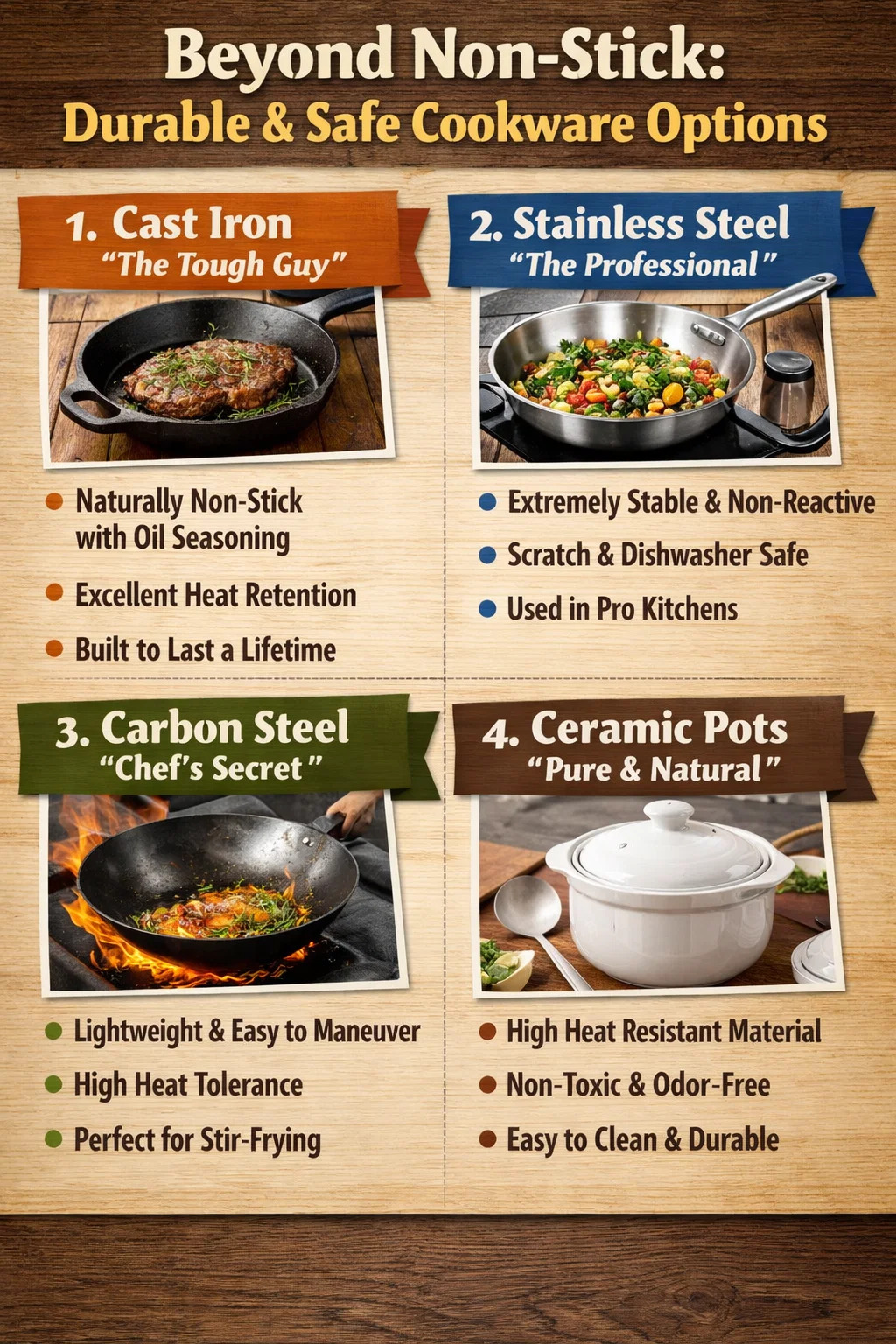
While modern non-stick cookware is safe under normal use, if you're looking for cookware that's completely worry-free, without concerns about coating flaking or high-temperature issues, there are indeed several more robust and reliable alternatives.
Here are a few options that offer greater durability and material stability than ordinary non-stick pans:
1. Cast Iron – The "tough guy" that gets better with age
If you want a pan that can be passed down to the next generation, cast iron is definitely the top choice.
Naturally non-stick: It has no artificial chemical coating. By "seasoning" the pan with oil, the oil penetrates the tiny pores on the iron surface, forming a natural protective film. This film thickens with use, and the non-stick effect improves over time.
High safety: Even if you scrub it vigorously with a steel wool pad or heat it intensely, it won't produce any harmful substances. The only thing that might enter the food is a trace amount of iron, which is actually beneficial for many people.
Excellent heat retention: It stays hot for a long time after the heat is turned off, making it ideal for slow-cooking stews or searing steaks to perfection.
2. Stainless Steel – The "professional" in the kitchen
You'll find almost exclusively this type of pan in the kitchens of high-end restaurants.
Extremely stable material: Stainless steel is a very stable metal and does not react chemically with food. Whether you're cooking acidic tomato sauce or stir-frying with vinegar, it maintains its original color and flavor without any concerns about impurities leaching out.
Durable and scratch-resistant: You can use metal spatulas freely and even put it in the dishwasher. Although it requires some skill in controlling the heat (it's prone to sticking if the heat is too high), from a durability and hygiene perspective, it's far superior to non-stick cookware.
3. Carbon Steel – The chefs' little secret
It's a "hybrid" of cast iron and stainless steel, combining the advantages of both.
Lighter than cast iron: Its principle is the same as cast iron, requiring an oil film for non-stick properties, but it's much lighter than cast iron, making it easy to handle with one hand. Physical Advantages: Unlike ordinary non-stick cookware, it's not afraid of high temperatures. You can heat it until it's red-hot for stir-frying without worrying about any coating decomposition issues. It's a favorite among many cooking enthusiasts who pursue that "wok hei" (wok aroma).
4. Ceramic Pots – The epitome of pure materials
This refers not to aluminum pots with coatings, but to pots made entirely of fired clay or those with a thickened natural ceramic surface.
High temperature resistance and durability: Ceramic material comes from clay and is inherently very heat-resistant. Its properties remain extremely stable during cooking, and it won't produce any strange odors, even when simmering herbal medicines or stewing soup for extended periods.
Smooth and easy to clean: Although its physical non-stick effect may be slightly inferior to professional non-stick cookware, its advantage lies in its hard surface that is less prone to scratches, making it much less stressful to use.